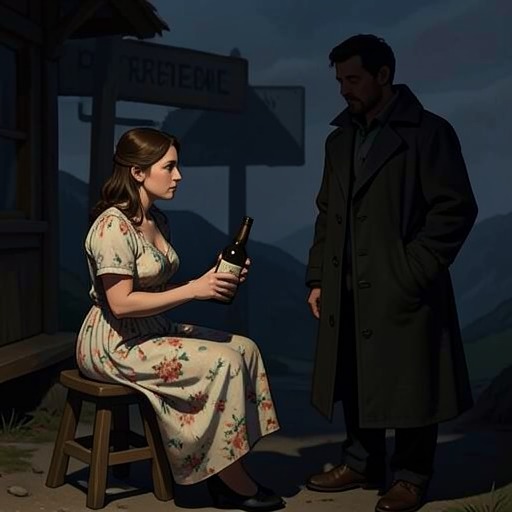
Phil Burbank–Rose Gordon: Harassment and Pressure Around Her Drinking
The Power of the Dog (Thomas Savage Edition)Phil Burbank’s relationship with Rose Gordon Burbank is an antagonistic in-law bond shaped by resentment, mockery, and calculated pressure. After George Burbank secretly marries Rose and brings her to the ranch, Phil regards her as a threat and makes her life there miserable through a thousand small, often concealed humiliations. His hostility later reaches beyond direct harassment: when Rose’s drinking becomes a vulnerability, he imagines using it to separate her from Peter and leave her increasingly alone.
Marriage and the Origin of Hostility
Phil’s resentment begins with George’s marriage to Rose, a doctor’s widow. He suspects that she is scheming for the Burbank money, and the couple’s move into the large master bedroom formerly occupied by the Old Gentleman and the Old Lady makes the change in the household unmistakable. Rather than accepting Rose as George’s wife, Phil interprets her presence as an intrusion and devotes himself to making her life at the ranch a living hell through persistent mocking and secret acts. The hostility is therefore not limited to a single quarrel: it becomes an ongoing method of treating her as an unwelcome outsider in her own marriage and home.
This opposition is intensified by the difference in how the brothers respond to Rose. George has chosen to marry her; Phil’s contempt for the marriage makes her an object of suspicion and ridicule. The narrative connects his repeated treatment of her with her eventual secret drinking, presenting the pressure within the household as consequential rather than merely unpleasant. Her vulnerability is not simply something Phil notices after it exists: his campaign against her contributes to the conditions in which she begins to tipple in private.
The Hides and the Language of Blame
When Phil discovers that the hides are gone, he immediately turns his anger toward Rose. He rides into the barnyard and tells Peter that every hide has disappeared; when Peter asks whether she sold them, Phil confirms that she did, while also allowing for the possibility that she gave them away. Peter points out that Rose knew the hides were needed and asks why she would act against that need. Phil answers by attributing the sale to drunkenness, using a contemptuous label for her condition and invoking the medical books Peter’s father left him as though they could classify Rose under the letter A.
That exchange establishes both the material conflict and Phil’s way of speaking about Rose. The missing hides matter because the ranch needed them, but Phil makes the incident an occasion to define her through alcohol. His diagnosis is delivered as an insult, not as a compassionate attempt to understand her; the reference to Peter’s books turns knowledge into a weapon in a conversation about his mother. The scene presents Phil’s explanation as his accusation. It does not give Rose’s own account of why she sold the hides, so his claim that drunkenness explains her action should not be mistaken for her stated motive.
Peter asks whether Phil will say anything to Rose. Phil refuses, saying that it is no skin off his back and that George will confront her instead. His refusal is not reconciliation or restraint: it leaves the confrontation to George while Phil uses the incident to ridicule Rose in front of her son. The choice also exposes an asymmetry in the household. Phil can make a damaging judgment about Rose without addressing her directly, while the prospect of dealing with the consequences is shifted onto George.
Drinking as a Weapon
The broader account of their relationship makes clear that Rose’s drinking is not merely a subject of Phil’s comments. After George’s marriage, Phil’s many mocking and secret forms of harassment help drive her toward secret tippling. Later, when he sees that Peter has courage and might be receptive to a man’s friendship, Phil imagines an additional use for the same vulnerability. He reasons that if he can draw Peter away from his mother, Rose will feel deserted and depend more and more on alcohol.
This calculation changes the shape of the hostility. Phil is no longer only trying to make Rose uncomfortable or to express his suspicion of her; he considers how to turn the mother–son bond against her. In his anticipated chain of events, Peter’s friendship with him produces Rose’s isolation, her increased drinking, and ultimately George’s rejection of her. The stated possibility that George will cast Rose off belongs to Phil’s expectation, not to a confirmed outcome in this evidence. What is established is the coldness of the plan: he sees her distress as a foreseeable consequence he can exploit.
Peter and the Intended Isolation
Phil’s approach to Peter is therefore inseparable from his antagonism toward Rose. He begins overtures to the boy by offering the rawhide rope he is braiding, instruction in roping and riding, and the prospect of friendship with a man. The offer appears to open a connection between Phil and Peter, but Phil’s expressed intention gives that connection a second purpose: to wean Peter away from his mother. Rose is not present in the exchange, yet she is the person Phil expects the new friendship to injure.
The episode links the hides, Rose’s drinking, and Peter’s summer on the ranch without making them interchangeable incidents. The missing hides give Phil an immediate occasion to blame Rose’s alcoholism; his longer plan turns that same condition into leverage against her. His apparent silence about the sale does not signal that the conflict has ended. Across these moments, he shifts from mocking Rose directly to calculating how Peter’s attachment might deepen her dependence and abandonment. The relationship’s defining pattern is thus sustained hostility joined to pressure: Phil treats Rose’s distress not as a reason to stop, but as something he can use to weaken her ties within the household.